

Building law in one place, AI answers with sources
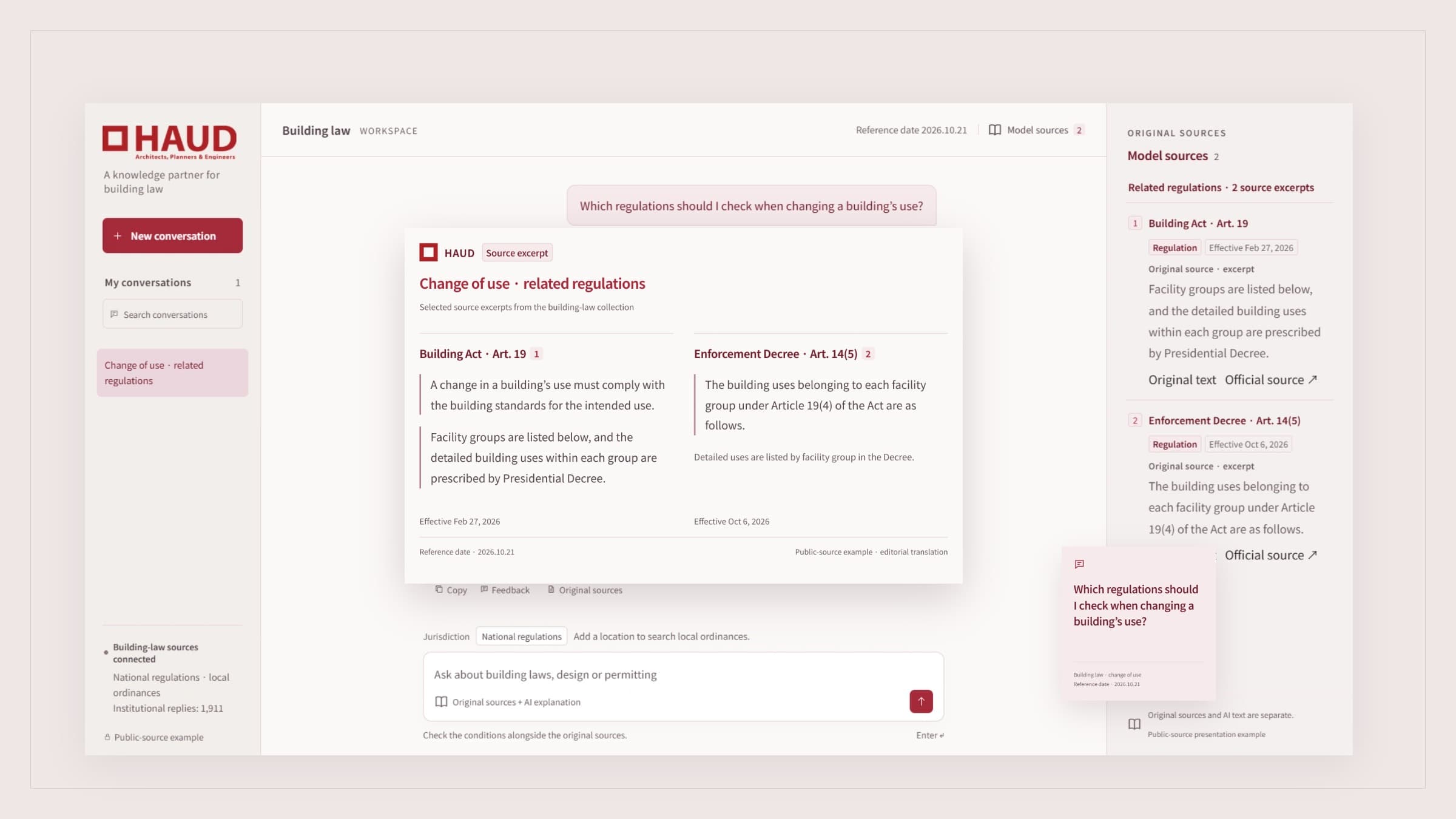
A building-law assistant that brings national legislation, administrative rules, local ordinances and agency interpretations into one place. It pairs explanations with source texts for practical questions about design, permitting and changes of use.
Laws, ordinances and 1,911 agency interpretations
- Customer
- HAUD Engineering
- Areas
- Codes · Review
- Deployment
- Login-based web service · PoC
- 1
Problem
Design and permitting reviews rarely depend on the Building Act alone. Questions about use, site conditions, parking and height require checking national legislation, subordinate rules, local ordinances and agency interpretations together. Their sources and effective dates differ, so the material needs to be connected for review.
- 2
Input
The collection brings together building-related national legislation, administrative rules, local ordinances and agency interpretations. Users enter a design or permitting question and a reference date, adding a location or building conditions when needed.
- 3
How it works
A PostgreSQL-backed collection keeps original texts, effective dates and editions distinct. Relevant regulations, ordinances and agency interpretations are supplied to the AI, while the deployed conversation interface separates explanations from source texts. Each interpretation is linked to the law as it stood when it was issued and as of your reference date; unconfirmed dates and links are marked as unconfirmed.
- 4
Output
Users receive an AI explanation alongside related regulations and agency interpretations, with dates and source texts available for review. They can reopen or export saved conversations and leave feedback on issues they find. The final application still requires checking the design conditions against the original sources.
Results
- Preserved 687 agency interpretations and added 1,224 from an official API, bringing the collection to 1,911. (As of October 21, 2026)
- Expanded to a PostgreSQL-backed collection covering building-law questions about design, permitting, use, parking and site conditions, with national rules and local ordinances within the collection scope.
- Tracked each interpretation's source and date, and its links to the law at each reference date, so the basis can be checked.
- Deployed a web service with login, saved conversations, session resumption, original-source viewing and feedback collection.
Could this work on your projects?
Tell us about your challenges, and we'll explain how a similar approach could apply.
More case studies
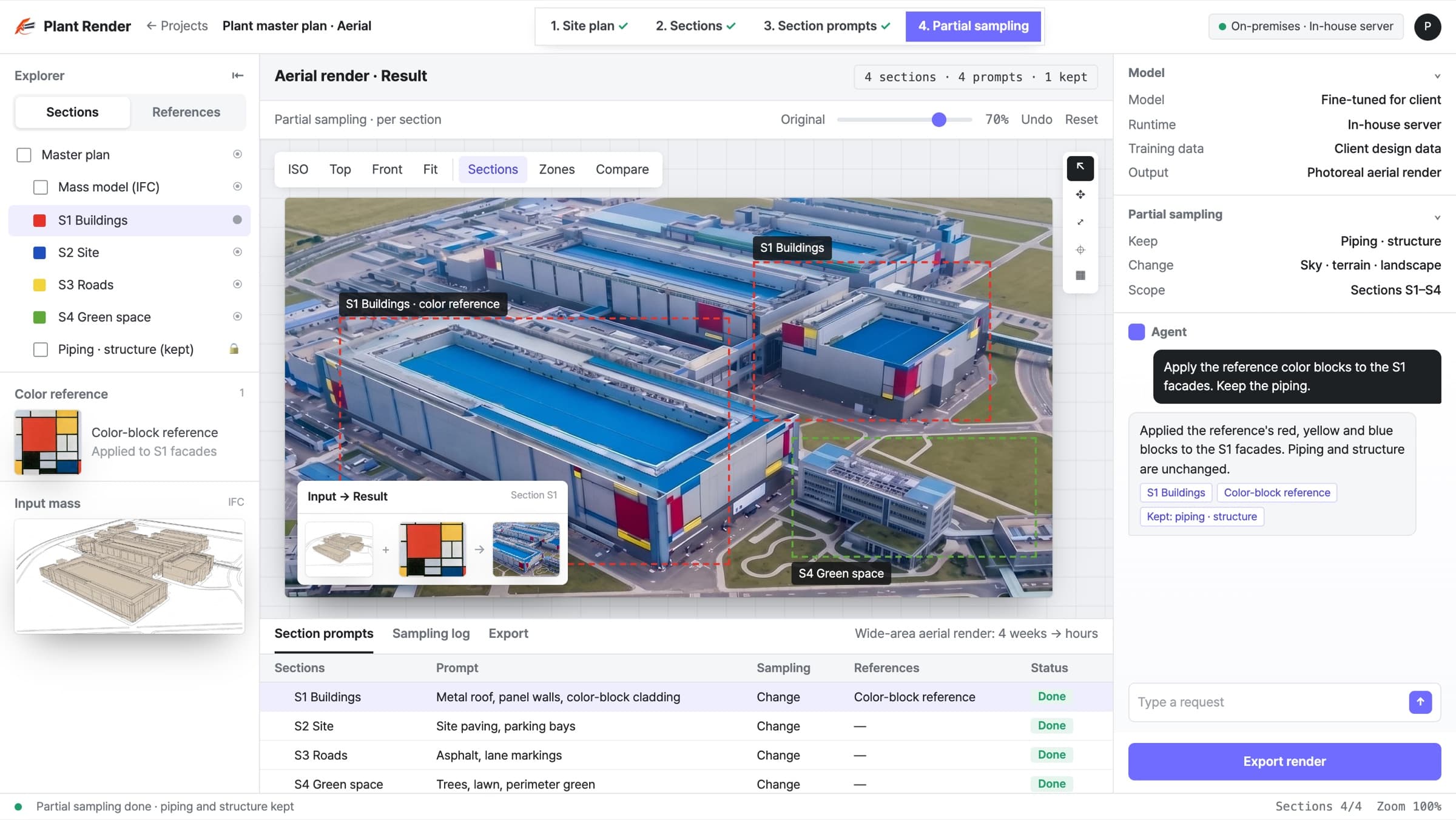

AI aerial rendering for industrial plants
Scattered design data, restructured so AI can use it. Fine-tuned models and section-level prompts run as a lightweight deployment on the client's own infrastructure.
Phase 1 built, now in maintenance and support
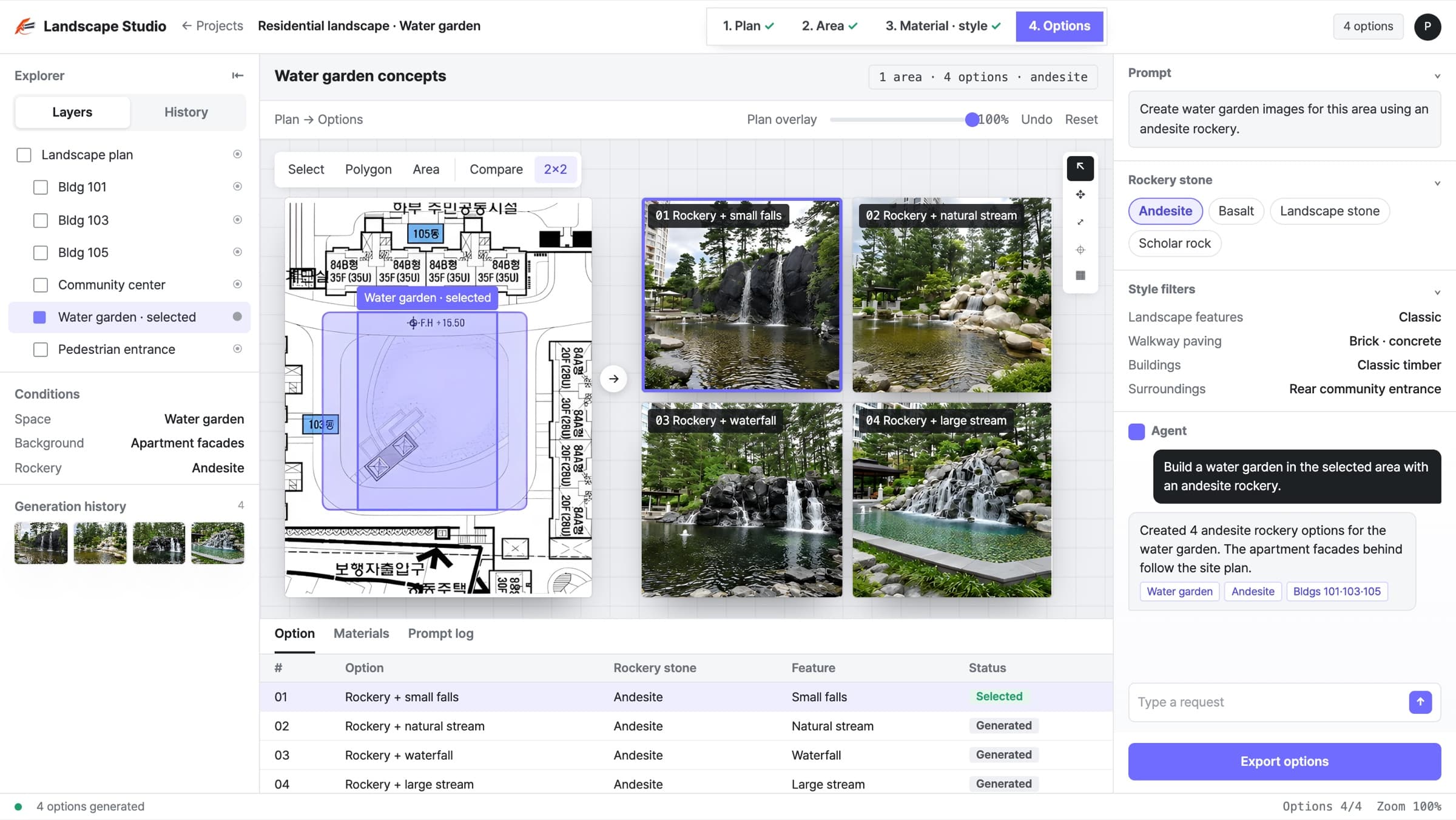

Landscape options from site plans
Select an area on an early landscape plan and describe what you want. A model trained on Korean residential landscapes generates the options.
4 landscape options per area, in one pass
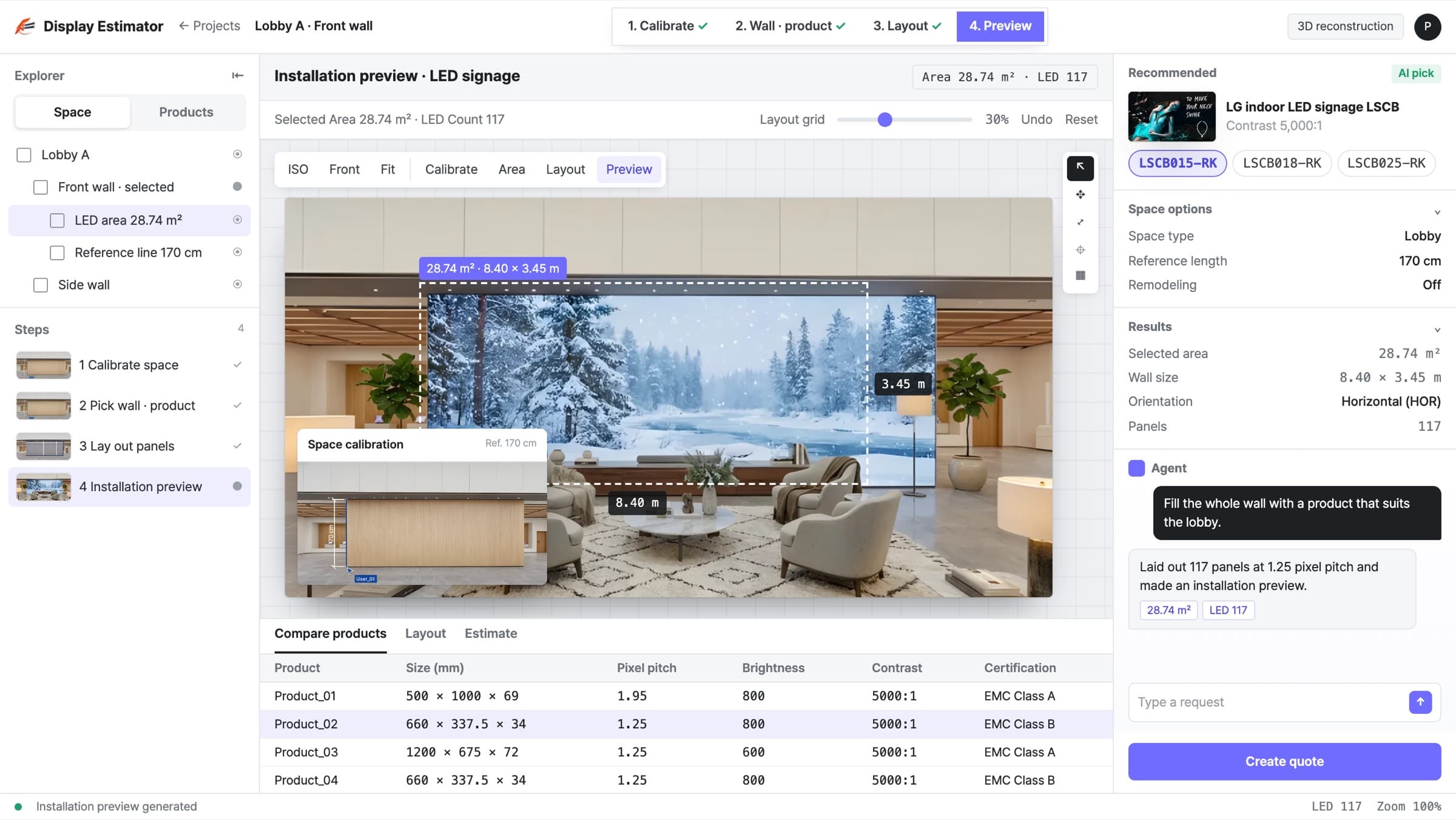

LED display quantity and cost estimation
Calculates wall area from a photo, recommends LED signage products and layout, then produces the estimate and an installation preview.
One photo to area, products, estimate and preview